


Limitless Potential of Data Ops and AI
Introduction

Traditional DataOps challenges


Inspironlabs, AI-Led DataOps Framework


Our Services enabling you to take informed decisions at early stages
We efficiently manage testing environments with our AI enabled tools, enabling create, duplicate, and isolate sandbox environments for testing and validation. This ensure production environment stability during development and testing.
What makes us more reliable in DataOPs
Limitless Potential of Data Ops & AI with InspironLabs!
Author’s Profile

Pavithra K • 6 March, 2026
How AI Is Reducing Testing Cycles from Weeks to Hours
The Real Cost of Slow Testing
Every day a release is delayed; it has a cost. A retail platform that misses a peak season window, a fintech app that cannot ship a compliance fix in time, a healthcare system that delays a patient-facing feature — these are not abstract scenarios. They are the direct result of testing cycles that can no longer keep pace with release demands.
The problem is not that teams are working slowly. The problem is that traditional testing approaches were designed for a different era — when applications were stable, releases were quarterly, and a three-week regression cycle was considered acceptable. That era is over.
Today, the industry standard is continuously delivered. Development teams push codes daily. Business stakeholders expect weekly releases. And yet many QA teams are still running the same manual regression suites and fragile automation scripts that were built five years ago.
The gap between how fast teams want to release and how fast they can safely release is the testing gap. AI is what closes it.



Why Traditional Testing Approaches Break Down
Manual testing and static automation scripts both share the same fundamental limitation: they do not adapt. When an application change — and applications change constantly — the test suite breaks. Someone has to fix it. That someone is a QA engineer who could be doing higher-value work.
The compounding effect is what makes this so damaging. A fragile automation script breaks on Monday. The fix will take two days. Meanwhile, the regression cycle has not started, the release is waiting, and the development team is context-switching to explain what changed. By the time the tests run, the window for a same-week release has closed.
Common patterns that lead to this breakdown include:
- Regression suites that take 10–15 days to execute manually
- Automation coverage that plateaus at 40–50% because scripts are too expensive to maintain
- Defects found in production that were not caught in testing due to time pressure
- QA teams spending more time maintaining tests than designing them
- Release decisions made on incomplete test coverage because there was no time to finish.
These are not edge cases. They are the norm for organizations that have not yet modernized their QA approach.
How AI Fundamentally Changes the Testing Model
AI does not simply make existing testing faster. It changes what testing is. Instead of executing a fixed set of scripts against a fixed set of test cases, AI-driven testing systems analyze patterns, adapt to change, prioritize intelligently, and integrate continuously. The result is a testing capability that scales with the application rather than lagging it.
There are four areas where this transformation is most visible.
1. Self-Healing Automation
Traditional automation breaks when UI elements change. Self-healing automation does not. When a button ID changes, a form field moves, or a workflow is restructured, AI-based automation recognizes the new structure and adjusts without manual intervention.
Real-world impact: A fintech application updated its login and onboarding flow mid-sprint. With self-healing automation, the suite adjusted automatically and continued executing the same day — zero downtime in the regression cycle.
2. Risk-Based Test Prioritization
AI systems analyze historical defect data, code change patterns, and business criticality to identify which areas of the application carry the highest risk at any given time. The result is a smaller, smarter test suite that focuses on effort where it matters most.
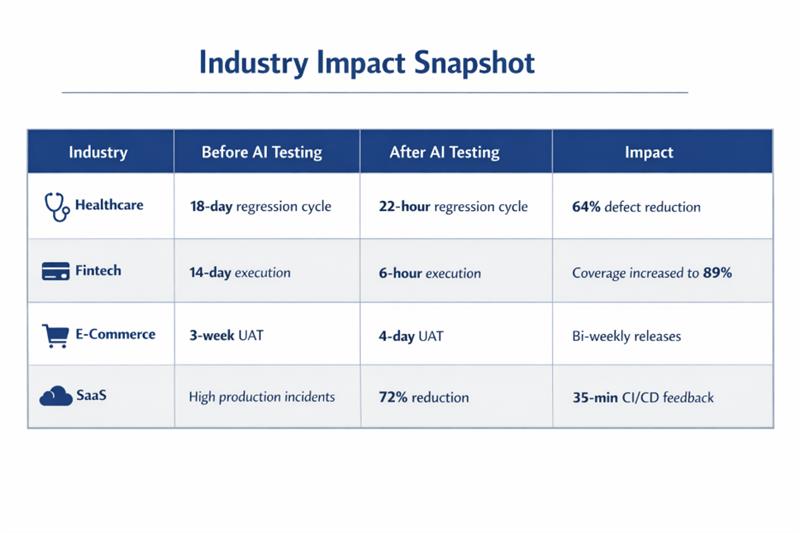
Real-world impact: An e-commerce platform reduced its regression suite from 1,200 to 380 high-priority test cases without reducing defect detection. Coverage of critical paths — checkout, payment, order confirmation — increased from 67% to 94%.
3. Predictive Defect Detection
Predictive models flag high-risk modules before testing begins, trained on historical defect clusters, code complexity metrics, and change frequency. QA teams allocate effort proactively rather than reactively.
Real-world impact: A healthcare software system used predictive analytics to identify the three modules most likely to contain defects in each sprint. Production defect rate dropped by 64% over two release cycles.
4. Continuous Testing in CI/CD Pipelines
AI-driven testing integrates directly into build pipelines, running targeted regression checks on every code commit. Developers receive test results within minutes rather than waiting for a batch run at the end of a sprint.
Real-world impact: A SaaS platform reduced build feedback time from 4 hours to 35 minutes and moved from bi-weekly to daily releases with no increase in QA headcount.
InspironLabs Best Practices in AI-Driven Testing
At InspironLabs, delivering faster and more reliable testing outcomes is not just about deploying the right tools — it is about following a disciplined set of practices that have been refined across dozens of client engagements. These are the industry‘s best practices that guide every testing program we build.
Test Design & Strategy
1. Start with a Risk Map, not a Test Plan
Before writing a single test case, InspironLabs conducts a risk mapping exercise to identify the highest-impact areas of the application. Testing effort is allocated based on business criticality, change frequency, and historical defect density — not assumptions or habits.
2. Design for Maintainability from Day One
Test cases are written with long-term maintenance in mind. This means clear naming conventions, modular design, separation of test data from test logic, and version-controlled repositories. A test suite that is easy to maintain is a test suite that actually gets maintained.
3. Define Done Correctly
A feature is not ready for release until it meets defined coverage thresholds, passes regression checks, and has been reviewed against acceptance criteria. InspironLabs establishes these standards with each client at the start of every engagement, not at the end.
AI Tool Implementation
1. Pilot Before You Scale
New AI testing tools are always validated on a single high-risk module before being rolled out across the full test suite. This allows teams to measure real performance gains, identify integration issues, and build confidence before committing a wider adoption.
2. Treat AI Output as a Starting Point
AI-generated test cases and defect predictions are reviewed by experienced QA engineers before being acted upon. AI accelerates the process — it does not replace human judgment on edge cases, business logic, or compliance requirements.
3. Monitor and Retrain Models Continuously
AI models drift over time as applications evolve. InspironLabs establishes feedback loops where defect outcomes, false positives, and missed detections are fed back into the model to keep predictions accurate and relevant.
CI/CD Integration
1. Shift Testing Left — Then Shift It Further
Unit tests run on every commit. Integration tests run on every pull request. Regression tests run on every build. InspironLabs helps clients establish testing gates at every stage of the pipeline, so defects are caught as close to their origin as possible.
2. Use Parallel Execution to Eliminate Waiting
Long test suites are broken into parallel execution streams so that a 4-hour sequential run becomes a 30-minute parallel run. This is one of the highest-ROI optimizations available and is built into every CI/CD testing architecture InspironLabs designs.
3. Build Dashboards That Drive Decisions
Every CI/CD pipeline integration includes a real-time test results dashboard that shows pass/fail status, coverage trends, and flagged risks in a format that both QA engineers and non-technical stakeholders can act on. Visibility drives accountability.
Team Collaboration & Culture
1. QA Joins Sprint Planning — Not Just Sprint Review
Testing is most effective when QA engineers are involved from the moment a story is written. InspironLabs embeds QA input into requirement reviews, definition of ready, and acceptance criteria discussions so that testability is designed in, not bolted on.
2. Share Defect Knowledge Across the Team
Defect patterns are reviewed in retrospectives, not just sprint demos. InspironLabs facilitates regular defect triage sessions where developers and QA engineers review what was missed, why, and what process change prevents it from happening again.
3. Invest in Continuous Learning
AI testing tools evolve quickly. InspironLabs maintains an internal knowledge-sharing culture where engineers regularly review new tooling, share findings from client engagements, and update internal frameworks to reflect what is actually working in production environments.
Measurable Outcomes Across Industries
The value of AI-driven testing is not theoretical. Organizations across healthcare, fintech, e-commerce, and SaaS have documented measurable improvements after modernizing their QA approach.
How to Get Started: A Practical Approach
The path from a three-week testing cycle to a three-hour one does not require rebuilding your entire QA process overnight. Organizations that attempt a full transformation at once typically stall. Those that start with one focused improvement consistently build the momentum to go further.
A proven starting point is to identify your single biggest bottleneck — the one part of your testing cycle that consistently delays releases — and apply AI-driven tooling there first. For most teams, this is either regression execution time or automation maintenance overhead.
From that first win, the pattern becomes clear. The framework extends. The coverage grows. And what once required for a two-week window becomes an overnight run that delivers results before the team arrives in the morning.
How InspironLabs Delivers This in Practice
InspironLabs Work with organizations to identify where AI-driven testing will create the most immediate value and builds from there. The approach is practical, not prescriptive — every engagement starts with the client’s current state and builds toward a quality engineering model that scales with their release of velocity.
What distinguishes the InspironLabs approach is the combination of technical depth and domain expertise. The team understands both how AI testing tools work, and the specific regulatory, compliance, and business logic challenges that make healthcare, fintech, and enterprise software testing uniquely complex.
Teams at InspironLabs operate with a continuous improvement mindset — QA, development, and AI specialists working together, not in silos. The goal is not to implement a tool. It is to build a testing capability that gets smarter with every cycle.
Conclusion
Testing cycles that are once consumed in three weeks are now completed in under 24 hours. Technology is proven. The framework exists. The only question is how long your organization can afford to stay on a two-week regression cycle while competitors are shipping daily.
The gap between fast teams and slow teams is no longer about headcounts. It is about intelligence built into the process. Teams that begin integrating predictive defect detection and self-healing automation today are building the quality engineering foundation that tomorrow’s release speeds will demand.
If your team is still treating testing as the last gate before release, that is exactly the right place to start.
Discover how AI-driven testing can transform your quality engineering strategy.
Visit our website to explore InspironLabs’ AI Testing Services, implementation frameworks, and proven best practices across healthcare, fintech, SaaS, and e-commerce.
👉 Transform Your QA Strategy- Contact Us


